

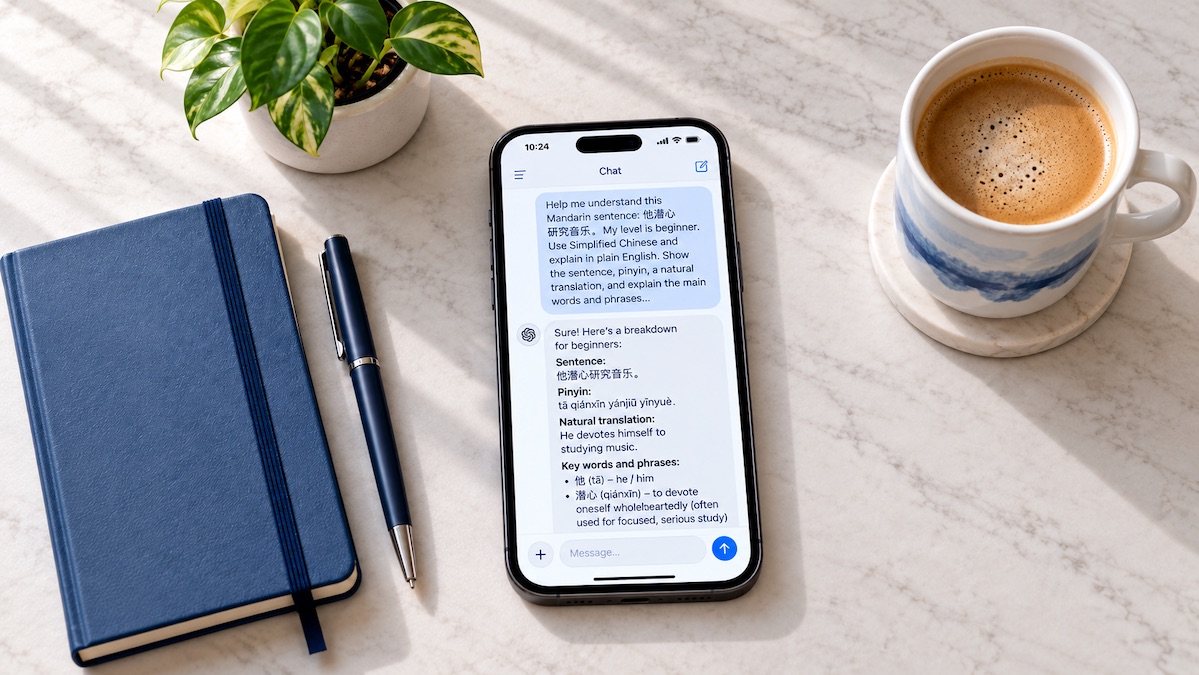
You've probably heard that AI can help you learn Mandarin. But if you've never tried it, you might be wondering where to start.
It's easier than you might think.
A prompt is simply what you tell an AI assistant to do. And getting a helpful answer often comes down to giving it the right details.
Imagine sending someone to the grocery store without telling them what you need. They might come home with a perfectly good bag of groceries, but none of the ingredients you actually wanted.
AI works much the same way. Tell it your Mandarin level, what you want to practice, and how you'd like it to respond. Those small details can make a surprising difference.
To help you get started, I’ve put together ten ready-to-use prompts that give you a head start. Just copy one, add your own details, and give it a try. Then experiment! Change the instructions, ask follow-up questions, or try a different approach. The more you tailor the conversation to your needs, the more useful AI can become for learning Mandarin.
Did you know AI can help you write the prompt itself?
You don’t have to figure out every instruction on your own. Describe what you want to practice and ask it to help you create a prompt. If you’ve tried a prompt but weren’t happy with the response, paste that prompt into the chat and explain what didn’t work. Then ask it to help you revise it.
A Few Things to Keep in Mind
AI can sometimes make mistakes, but that shouldn't discourage you from giving it a try. If a correction, translation, or example seems questionable, double-check it with a reliable dictionary, teacher or native speaker. A little checking can help you practice with more confidence.
Also, if a conversation gets especially long and the AI starts repeating itself, overlooking your instructions, or giving inconsistent answers, try starting a new chat. Just bring along the important details so you can pick up where you left off. Sometimes a fresh start makes all the difference in getting your study session back on track!
Ready to give it a try? Choose a prompt below that fits what you want to practice, replace the details in square brackets with your own, and paste it into your AI chat.
1. Create a Vocabulary List I'll Actually Use
Best for: Learning words and expressions for daily life, personal interests or an upcoming situation.
Instead of requesting a random vocabulary list, choose something you genuinely want to talk about. For example, you could ask for vocabulary related to your children, ordering vegetarian food, or describing your workday.
This prompt also asks for useful verbs, example sentences and a short writing exercise.
Copy this prompt:
Act as an experienced Mandarin Chinese tutor who specializes in teaching English-speaking learners.
Create a vocabulary list for [topic or situation]. Adapt your teaching to my [beginner/intermediate/advanced] level. Use [Simplified/Traditional] Chinese and explain in plain English.
Choose 10 useful words and short expressions appropriate to my level. Include the verbs and everyday phrases I need to talk about this topic, rather than filling the list with nouns.
Present a table with Chinese, pinyin with tone marks, and a clear English meaning. Group related items together. For nouns, include a common measure word where useful.
Below the table, give five short, natural example sentences using the most useful items. Include pinyin and English translations. Keep the other vocabulary simple.
Mark five items to learn first. Prefer ordinary spoken Mandarin over formal or obscure expressions. Mention regional differences only when they affect practical usage.
Finish by inviting me to write one sentence using an item from the list. Wait for my attempt, then explain any correction briefly.
2. Break Down a Sentence I Don't Understand
Best for: Understanding how a Chinese sentence works when knowing the individual characters isn't enough.
Sometimes you can recognize nearly every word in a sentence and still have trouble understanding what it means.
Paste a sentence from a textbook, message, subtitle or article. The AI will break it into meaningful parts, explain the grammar, and show you how to use the same pattern in other sentences.
Copy this prompt:
Act as an experienced Mandarin Chinese tutor who specializes in teaching English-speaking learners.
Help me understand this Mandarin sentence: [paste sentence]. Adapt your teaching to my [beginner/intermediate/advanced] level.
Use [Simplified/Traditional] Chinese and explain in plain English.
First show the sentence, pinyin with tone marks, and a natural English translation. Then divide it into meaningful words and phrases. Explain each part's meaning and role in this sentence. Keep words together rather than translating every character separately.
Explain the main sentence pattern and any small words that affect the meaning. If a literal translation would be misleading, explain why. If the sentence is ambiguous without context, say what information is missing instead of choosing a meaning with certainty.
Give two short examples using the same main pattern, with pinyin and English.
Finally, give me one easy sentence to complete using that pattern. Wait for my answer before providing feedback.
3. Help Me Say What I Mean
Best for: Expressing something naturally instead of translating English word for word.
Maybe you want to tell someone, “I'd like to help, but I can't stay very long,” or ask a friend whether they'd like to have dinner on Sunday.
You know what you want to say in English, but you're not sure how a Mandarin speaker would express it.
This prompt considers the situation, who you're speaking to, and your Chinese level. It also helps you practice adapting the expression rather than simply memorizing a translation.
Copy this prompt:
Act as an experienced Mandarin Chinese tutor who specializes in teaching English-speaking learners.
Help me express this naturally in Mandarin: [what you want to say]. Adapt your teaching to my [beginner/intermediate/advanced] level.
I am speaking or writing to [person] in [situation]. Use [Simplified/Traditional] Chinese and explain in plain English.
Give the most suitable everyday version first, with pinyin with tone marks and an English meaning. Preserve my intended message and tone. If something important is unclear, ask one clarifying question before translating.
If a simpler version would help someone at my level, provide it and explain any meaning it leaves out. Give no more than one additional alternative, and only if it serves a clear purpose, such as being more polite or more casual.
Explain one useful phrase or sentence pattern I can reuse. Do not make the wording formal or literary unless the situation calls for it.
End with a small change to the situation and invite me to adapt the sentence myself. Wait for my response.
4. Show Me How to Use This Word
Best for: Learning how to use a familiar word beyond its dictionary definition.
Recognizing a word and knowing how to use it are two different things.
Choose a Chinese word or expression you've recently learned, and ask for examples of how it appears in everyday Mandarin.
You can also include a sentence where you've encountered the word. This helps the AI focus on the meaning that's relevant to you.
Copy this prompt:
Act as an experienced Mandarin Chinese tutor who specializes in teaching English-speaking learners.
Teach me how to use this Mandarin word or expression: [word or expression]. Adapt your teaching to my [beginner/intermediate/advanced] level.
Use [Simplified/Traditional] Chinese and explain in plain English.
If I provide a sentence containing the word, explain that usage first: [optional sentence].
Give its pinyin with tone marks and its most relevant everyday meaning. Where useful, show up to three common word combinations or sentence patterns. Include only those that help explain its natural use; do not force combinations to reach a particular number.
Then give four short, natural examples showing how to use the word or expression. Use sentences or brief conversational exchanges, whichever fits best. Vary the context where appropriate without forcing it into situations where it would not naturally belong. Include pinyin and English translations. Keep the surrounding language appropriate to my level.
If the word has several meanings, focus on the most useful one first and briefly flag other common meanings. Explain one important restriction or common mistake if relevant; do not invent a warning just to fill space.
Then give me a situation where I could use the word and ask me to write a sentence. Wait for my answer. Explain whether my usage works and preserve any wording that is already natural.
5. Explain the Difference Between These Words
Best for: Choosing between Chinese words that have similar English translations.
Some Mandarin words seem interchangeable when you look them up in a dictionary, but they aren't always used in the same situations.
For example, 知道 (zhīdào) and 认识 (rènshi) can both mean “know,” while 二 (èr) and 两 (liǎng) both mean “two.” So how do you know which one to use? This prompt helps you understand the differences and recognize when each word fits naturally.
Copy this prompt:
Act as an experienced Mandarin Chinese tutor who specializes in teaching English-speaking learners.
Explain the practical difference between [word A] and [word B] in Mandarin. Adapt your teaching to my [beginner/intermediate/advanced] level.
Use [Simplified/Traditional] Chinese and explain in plain English.
Start with a short explanation in plain English. Focus on meaning, common combinations, and situations where I would choose one over the other.
Give three short examples that make the distinction clear, with pinyin with tone marks and English translations. Where useful, show what happens if the words are swapped: whether the sentence becomes incorrect, less natural, or simply different in meaning.
Do not invent a rigid distinction if their uses overlap. Identify regional or formal-versus-casual differences when relevant.
Then give me three short practice questions, one at a time, and wait after each. Ask me to choose a word for a specific context. Accept either answer when both work and explain the difference.
6. Check My Chinese and Explain the Changes
Best for: Correcting Chinese sentences, messages, homework and short paragraphs.
AI can be a helpful second "set of eyes" when you're writing in Mandarin, especially when you don't have a teacher or language partner immediately available.
But AI sometimes rewrites perfectly good Chinese into something unnecessarily complicated. This prompt asks it to correct actual mistakes, explain why they're wrong, and distinguish corrections from optional improvements without changing your meaning or writing above your level.
Copy this prompt:
Act as an experienced Mandarin Chinese tutor who specializes in teaching English-speaking learners.
Check my Mandarin: [paste your writing]. Adapt your teaching to my [beginner/intermediate/advanced] level.
I am writing to [audience] for [purpose]. Use [Simplified/Traditional] Chinese and explain in plain English.
First tell me whether my meaning is clear. Then provide a corrected version that stays as close as possible to what I wrote. If the text is already correct and appropriate, say so.
Explain the changes briefly in English. Distinguish grammatical errors, unsuitable word choices, and optional improvements in style. Do not replace correct beginner language with advanced expressions just to make it sound more impressive.
If my intended meaning is unclear, ask before rewriting that part. Include pinyin with tone marks for corrected sentences or new expressions; for longer texts, avoid repeating the entire passage in pinyin.
If you made a correction, choose one useful correction and ask me to apply it in a new sentence. If no correction was needed, choose a useful expression or sentence pattern from my writing and ask me to use it in a new sentence. Wait for my response.
7. Make Something I Can Read Using My Vocabulary
Best for: Practicing reading with vocabulary you're already learning.
Our Reading Practice Hub has plenty of resources to help you find something to read. But what if you want to practice the exact words you're learning right now?
Give AI five to ten vocabulary words from a recent lesson, and it can turn them into a short passage suited to your level. Then test your understanding with a few comprehension questions.
Copy this prompt:
Act as an experienced Mandarin Chinese tutor who specializes in teaching English-speaking learners.
Write a short Mandarin reading passage using vocabulary I am learning: [paste words]. Adapt your teaching to my [beginner/intermediate/advanced] level.
Use [Simplified/Traditional] Chinese and explain in plain English.
The topic is [topic, or "choose something everyday"].
For a beginner, write five to eight short sentences with a clear, connected meaning. For a higher level, write a short paragraph appropriate to my ability. Use as many of my words as fit naturally, but do not force unrelated words into the passage.
Keep additional vocabulary simple. List up to five potentially unfamiliar words below the passage with tone-marked pinyin and English meanings.
Show the passage in Chinese characters first, without pinyin or an English translation. If I ask for help, provide pinyin with tone marks, an English translation, or both for the word, sentence, or full passage I request. If a comprehension question is waiting for my answer, give me the requested help, then wait for my answer before moving on.
Ask one straightforward comprehension question and wait for my answer. Let me answer in English or Chinese. Explain any misunderstanding, then ask the next question. After three questions, offer a full translation and briefly explain one useful sentence pattern.
8. Prepare Me for a Conversation
Best for: Learning what to say before encountering an unfamiliar situation.
Maybe you've been invited to a celebration, need to return something to a store, or want to introduce yourself to a Chinese-speaking neighbor.
Practicing beforehand can help you feel more prepared, especially when you're still learning basic conversational expressions.
This prompt starts with useful phrases, shows you a realistic exchange, and then lets you participate in a short practice conversation.
Copy this prompt:
Act as an experienced Mandarin Chinese tutor who specializes in teaching English-speaking learners.
Help me prepare for this Mandarin conversation: [situation and what you need to accomplish]. Adapt your teaching to my [beginner/intermediate/advanced] level.
Use [Simplified/Traditional] Chinese and explain in plain English.
Start with six useful phrases for this situation, including something I might hear from the other person and a way to ask them to repeat or explain. Give characters, pinyin with tone marks, and English meanings.
Then show a short, realistic sample conversation of six turns. Include Chinese, pinyin with tone marks, and an English translation for each turn. Keep it appropriate to my level and avoid unnecessary vocabulary.
After the example, practice with me. Take the other person's role and give only one short turn at a time. Wait for my reply. Let me answer in characters or pinyin.
If I get stuck, give a small hint. After my answer, briefly correct anything that affects meaning or naturalness, then continue. Do not claim to assess pronunciation from typed pinyin.
End after four exchanges, or sooner if I ask to stop or review. If I repeatedly get stuck, ask whether I would like to continue with simpler language or move straight to the review. Finish with up to two useful phrases from our conversation for me to practice, including pinyin and English meanings.
9. Turn My Lesson into Flashcards
Best for: Creating a set of vocabulary cards you can return to after a lesson.
You've finished a lesson, but the new words still need practice. Give AI your notes, and ask it to turn the useful words and expressions into a manageable set of flashcards.
Copy them onto cards or into your preferred flashcard app, then use them whenever you have a few minutes to review.
Copy this prompt:
Act as an experienced Mandarin Chinese tutor who specializes in teaching English-speaking learners.
Turn this lesson material into up to 12 vocabulary flashcards: [paste vocabulary, sentences, or notes]. Adapt the cards to my [beginner/intermediate/advanced] level. Use [Simplified/Traditional] Chinese and explain in plain English.
Choose useful words and short expressions from my material. Test one item per card, and avoid making several cards for the same item. If I provide fewer than 12 suitable items, make fewer cards.
Create a numbered table with a Front column and a Back column.
On the front, put a brief English cue asking me to recall the Mandarin word or expression. Add a short situation or usage clue when needed to make the intended meaning clear, without revealing the Chinese answer.
On the back, give the Chinese, pinyin with tone marks, and a concise English meaning. Include one short, natural example sentence with pinyin and an English translation. Keep the surrounding vocabulary simple.
Focus on the meaning used in my lesson rather than listing every possible definition. Where another common Mandarin expression also fits the cue, briefly acknowledge it rather than implying that only one answer is possible.
If something in my notes appears incorrect or is too unclear to use reliably, flag it before creating the cards. Explain any proposed correction, and leave unresolved items out.
Show the complete set at once so I can copy and reuse it. Do not start an interactive quiz.
10. Quiz Me on What I Just Learned
Best for: Checking whether you can use the vocabulary and grammar you've studied.
You understood the examples in your lesson. Can you use what you learned when the situation changes?
This prompt gives you a short, interactive quiz built around fresh examples. You'll complete sentences, choose expressions that fit a situation, and try putting your own thoughts into Chinese. Afterward, you'll have a clearer idea of what needs another look.
Copy this prompt:
Act as an experienced Mandarin Chinese tutor who specializes in teaching English-speaking learners.
Quiz me on this Mandarin material: [paste vocabulary, grammar notes, or a short lesson]. Adapt the quiz to my [beginner/intermediate/advanced] level. Use [Simplified/Traditional] Chinese and explain in plain English.
Ask eight short questions, one at a time, and wait for my answer after each. Use fresh examples to check whether I can apply the vocabulary and sentence patterns in my material. Keep the tested content within what I provide.
Choose a suitable mix of completing a sentence, choosing an expression for a clear situation, and writing a short response in Chinese. Use only question types that fit my material. Avoid isolated word-definition questions.
Keep the surrounding language appropriate to my level. Explain any necessary unfamiliar vocabulary without giving away the answer. Do not show model answers or other clues before my first attempt.
Accept answers in characters or pinyin. Accept valid alternatives, and distinguish actual mistakes from optional improvements. Do not assess spoken pronunciation from typed answers.
If my answer works, briefly explain why and continue. If it is incorrect or incomplete, give one useful hint and let me try again before showing a model answer. If I type “show answer,” provide it immediately. Include tone-marked pinyin and a brief English explanation with model answers.
Count the eight questions separately from retries. After question eight, revisit up to two points I struggled with using different examples.
Finish with a short summary of what I handled independently, what needed help, and up to three specific things to review. Do not count an answer given after a hint or explanation as an independent success.
If you try one of these prompts, I'd love to hear how it goes! Have another creative way to use AI for Mandarin practice? Share it in the comments. Your idea might help another learner!
Know of a helpful website or free collection featuring AI prompts for learning Mandarin? Use our Suggest a Resource form and we will take a look and see if it would be a good fit for our Resource Directory.
Feel free to copy and adapt these prompts for your own learning. If you’d like to share them, please link to this page instead of posting the prompts elsewhere. Sharing the link helps keep these free resources available to you.