

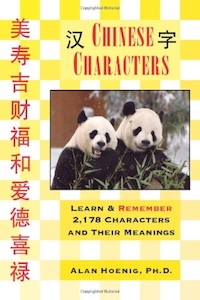
★ A systematic mnemonic approach helps learners remember more than 2,000 common Chinese characters by breaking them into meaningful visual components. Chinese Characters: Learn & Remember 2,178 Characters and Their Meanings by Alan Hoenig uses a building-block method to make character memorization more manageable. Characters progress from simple strokes and components to increasingly complex forms, with memory techniques connecting visual elements to their meanings. Entries also include pinyin pronunciation, component information, and indexes for reference. The book can work alongside a beginner Chinese course or serve as a character refresher for more experienced learners. Available through Google Books for a preview, AbeBooks for print copies and at other retailers.
Print Character Book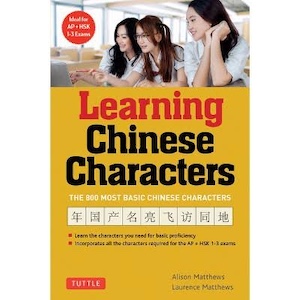
★ Uses memorable visual stories and mnemonics to help learners remember Chinese characters, meanings, pronunciations, and tones. Learning Chinese Characters by Alison Matthews and Laurence Matthews teaches more than 800 characters through visual imagery, mnemonic stories and a structured building-block approach. Entries include pinyin, radicals, stroke counts, traditional forms, compounds, and writing guidance, making it especially useful for learners who struggle with rote memorization. It is available as a printed book and ebook. Learn more from Tuttle Publishing. The ebook is available through Google Play Books on the web, Android and iOS. Also available through other retailers.
Printed Character Book / Digital
★ A comprehensive character reference that combines stroke order, pronunciation, meanings, usage, and memory aids. Reading & Writing Chinese by William McNaughton, revised by Jiageng Fan, is a reference book designed to help learners recognize, understand and write Chinese characters. The third edition covers 1,725 frequently used characters in simplified and traditional forms, with Hanyu Pinyin, definitions, character derivations, example compounds, stroke-order guidance, mnemonics, and indexes for easier lookup. It is especially useful for learners who want a structured printed reference for character study rather than a lesson-based textbook. Available from Tuttle Publishing and other retailers.
Printed Character Book
★ A systematic mnemonic method for breaking down and remembering thousands of Chinese characters. Remembering Simplified Hanzi and Remembering Traditional Hanzi by James W. Heisig and Timothy W. Richardson are paid print books that teach learners to remember the form and basic meaning of Chinese characters by breaking them into components and linking those components through imaginative stories. Each version consists of two volumes covering 3,000 characters in total, with Volume 1 introducing 1,500 characters and Volume 2 adding another 1,500. The method can be especially useful for learners who find characters difficult to distinguish or remember, but it focuses on character recognition, writing and meaning rather than pronunciation, tones, vocabulary usage, grammar or reading comprehension, so it is best used alongside other Mandarin learning resources. Available on the web from University of Hawaiʻi Press: Remembering Simplified Hanzi and Remembering Traditional Hanzi. Also available through other retailers.
Printed Character Books
★ Best for learners who want to understand how Chinese characters developed and use their origins as memory aids. The Way of Chinese Characters by Jianhsin Wu is a paid illustrated reference book that explains the origins and historical development of 670 commonly used Chinese characters. Each entry includes simplified and traditional forms, pinyin, English definitions, ancient script forms, character classifications, example words and phrases and illustrations that help connect a character’s earlier forms with its modern meaning. It is especially useful for beginning to intermediate learners who prefer understanding character structure and history rather than relying only on rote memorization, and it includes an index for coordinating character study with Integrated Chinese Level 1. A free sample is available from Cheng & Tsui, and the second edition is avaiable from BookRun. Also available through othe retailers.
Printed Character Book