
Welcome to the second installment of “Discovering Chinese Traditions and Celebrations.” Today get ready to be embraced by the sheer beauty of Traditional Chinese Weddings, where ancient traditions meet modern love stories.
Not fond of reading? Check out our video below.


THE CEREMONY
The contrast between Eastern and Western cultures is most apparent in their approach to wedding ceremonies. Couples in the West traditionally hold their wedding ceremony and reception on the same day. Their Eastern counterparts follow a much different tradition.
In the East, the wedding ceremony lacks any extravagant display, as the celebration will be held on a future date. This allows the couple to prioritize the legal aspects of their union.
Once the marriage is registered with the local government, many couples have a meal with family and close friends to rejoice and commemorate this significant milestone.
The couple’s focus then shifts to the exciting task of wedding planning. The coordination of various elements, such as the venue, food, decorations, and guest list, takes center stage. Meticulous planning ensures that every detail is accounted for, creating a memorable experience for all involved.
USE OF THE COLOR RED & DOUBLE HAPPINESS SYMBOL
One decision that doesn’t requires extra planning, is the prominent use of red in every aspect of the festivities. Red symbolizes good luck and happiness. From the delicate embroidery on bridal gowns to the enchanting lanterns illuminating the festivities, red is an integral part of the joyful atmosphere.
The Double Happiness symbol holds a special place in Chinese weddings, symbolizing joy, love, and marital bliss. It consists of two Chinese characters for “happiness” arranged side by side, often displayed in you guessed it, red.
This symbol is prominently displayed in various ways throughout the celebration. It can be found on invitations, decorations, the cake, favors, and even on the bride’s attire.
PHOTOGRAPHS
While the Western approach to wedding photography might focus on capturing candid moments and dynamic poses, the Chinese style cherishes the timeless and graceful aesthetic.
You might say that Chinese couples focus on the quality of their wedding photos rather than the quantity.
The official wedding photos, called 婚纱照 (hūn shā zhào), are taken separately from the ceremony and are usually finished weeks and even months before the wedding day.
Chinese couples often seek to make their wedding photos auspicious by incorporating various elements that symbolize luck, prosperity, and happiness. Some couples even consult a fortune teller to choose an auspicious date and time for the photoshoot.
When it comes to photography, another reason why the East and West differ lies in the importance of wedding banquets in Chinese culture.
In China, a lavish wedding banquet is a customary way of celebrating the union with family and friends. Couples often allocate more time to enjoy the festivities and engage in heartfelt conversations rather than dedicating long hours to endless photoshoots.
WEDDING DRESS
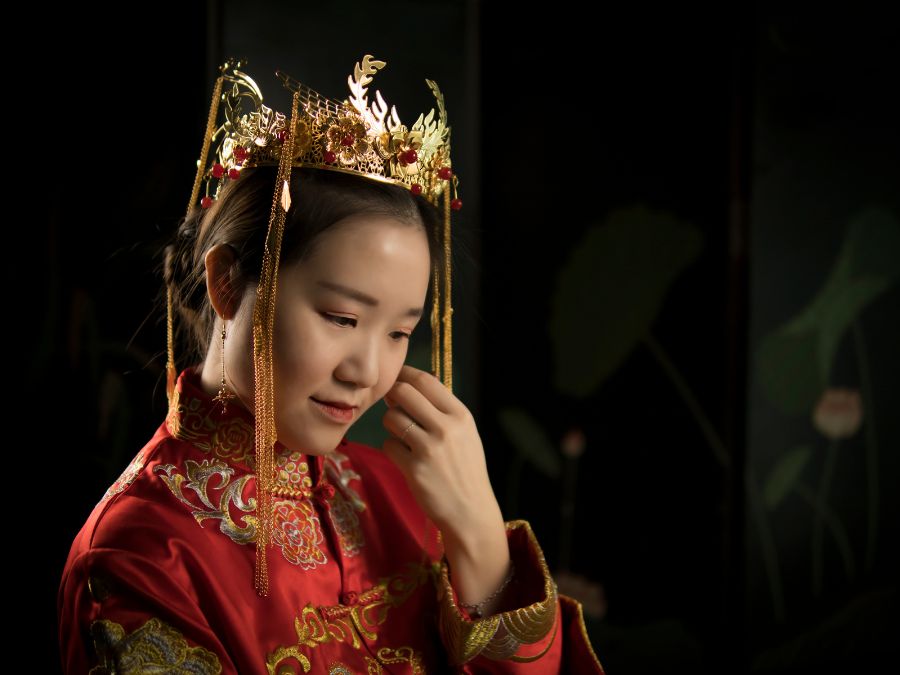
A traditional Chinese wedding dress is called a 旗袍 (qípáo). The vibrant red hue symbolizes good fortune and happiness. Modern interpretations also embrace other colors like gold, pink, or even white, reflecting changing tastes and personal preferences. The bride is also left to determine how traditional she wants her gown to be.
Traditional design elements include delicate embroidery, often showcasing motifs like dragons, phoenixes, flowers, and peonies. These symbols represent good luck, harmony, fertility, and everlasting love.
The traditional gown is also said to emphasize the concept of yin and yang, that is “the balance between opposing forces.” The fitted silhouette of the dress, with its high collar and slits, combines the contrasting elements of modesty and sensuality. Some Chinese also feel it encapsulates the idea of a harmonious union between the bride and groom, symbolizing the merging of complementary energies.
The Chinese wedding gown is often cherished as a family heirloom that holds immense sentimental value. So, it is not uncommon for brides to wear a gown that has been passed down through generations. This practice connects the present with the past, creating a profound sense of shared history.
Interestingly, unlike the West, the Chinese aren’t superstitious about the groom seeing his bride in her dress beforehand, adding an extra dose of excitement and trust to the occasion.
ANIMAL SYMBOLISM
Many Chinese feel that including animal symbolism in their wedding adds a touch of charm and meaning to the celebration. It’s like having a secret language of animals woven into the festivities!
Let’s quickly go through the top 5 animal symbols seen in Chinese weddings:
- DRAGON: The mighty dragon is a symbol of power, strength, and good fortune. It represents the groom and is often featured on the wedding attire, decorations, and invitations.
- PHOENIX: The elegant phoenix is the counterpart of the dragon and symbolizes the bride. It represents beauty, grace, and harmony. You may spot the phoenix on the bride’s dress or accessories, and many feel it adds a regal touch to the celebration.
- CRANES: Cranes are admired for their long life and loyalty in Chinese culture. They symbolize longevity, happiness, and eternal love. You might see cranes depicted on wedding decorations, invitations, and even as origami creations.
- MANDARIN DUCKS: These adorable birds are a symbol of love and fidelity. Mandarin ducks mate for life, making them perfect symbols for the married couple. They are often depicted together in wedding decorations, showcasing the importance of loyalty and commitment in a marriage.
- FISH: In Chinese culture, fish represent abundance and wealth. The word for fish, 鱼 (yú), sounds similar to the word for surplus, so having fish motifs or even live fish at the wedding banquet is believed to bring prosperity to the couple’s future life.
TEA CEREMONY
In Chinese culture, the tea ceremony holds great significance and has been a part of weddings for centuries.
It’s a way for the couple to pay respects to their elders and show gratitude for their guidance and blessings.
Typically, the tea ceremony takes place after the wedding ceremony. The couple, all dressed up in their stunning wedding attire, sits at a beautifully decorated table. There you’ll find all the essentials: tea sets, cups, and, of course, fragrant tea leaves. It’s all about creating an ambiance of tranquility and warmth.
The groom’s parents are served first as the couple kneels before them, holding the tea-filled cups, which they then offer respectfully. This act symbolizes the couple’s appreciation for their parents’ love, support, and wisdom throughout their lives.
Next, the bride’s parents are honored as the couple repeats the ritual of kneeling and serving tea, once again expressing their gratitude for their care and upbringing.
In Chinese culture, tea represents harmony, purity, and fertility. So, by serving and drinking tea, the couple signifies their wish for a harmonious and fruitful life together.
RED ENVELOPES
As a token of good luck and blessings, family members and guests may give the couple red envelopes filled with money. Red envelopes are called 红包 (hóng bāo) in Chinese. This act symbolizes their good wishes for the couple’s prosperous future.
My friend Evan, from 洛阳 (Luòyáng), China discussed red envelopes with me at length. He said, “In China, red envelopes serve as a replacement for the gift registries common in the West.”
When preparing a red envelope, Chinese people avoid filling it with money in multiples of four. This is because the Chinese word death, 死 (sǐ), sounds similar to the word four, (四, sì). On the other hand, many see the numbers six and eight as auspicious and often give money in multiples of those numbers.
In the West, the bride’s parents typically pay for the wedding, but not so in the East. Evan helped me to appreciate that the cost of the wedding, and often the couple’s first home, is the responsibility of the groom’s family. The money obtained from red envelopes is often used to offset these costs.
Traditionally, reciprocity reigns supreme in China and is considered a way to build and maintain friendships. Thus, according to Evan, it is not uncommon for Chinese people to keep a list of the people who gave them money and how much was given. In this way, they can be sure not to shortchange the giver when it is his or his child’s turn to receive.
WEDDING DAY GAMES
Weddings in China are a big deal, and you know what makes them even more exciting? Games! Yep, that’s right, games are a fantastic way to add fun and joy to Chinese wedding celebrations. Let’s briefly learn about the four most common games played during the festivities.
First up, we have “Door Games.” Imagine a brave groom surrounded by his groomsmen, ready to prove his love and dedication. But hold on, there’s a catch! The bride’s friends and bridesmaids are guarding the door, demanding challenges to allow entry.
From singing love songs to solving riddles, the groom must showcase his wit and charm to win their approval. It’s like a quest for true love, where every challenge brings him closer to his princess!
Next, we have the famous “Bridal Shoe Game.” The couple sits back to back, holding one of their own shoes and one of their partner’s shoes. A series of playful questions are fired at them, like “Who’s the messier one?” or “Who’s the better cook?”
Then, in a hilarious display of unity or playful rivalry, the couple raises the shoe belonging to the person they think fits the question best. It’s a delightful way to reveal their quirks and bring out the laughter in everyone!
Next up is the “Red Envelope Game.” As I mentioned earlier, Chinese weddings often involve red envelopes filled with money as gifts. But here’s the twist: guests take turns dancing or performing on stage to entertain the couple. The more captivating the performance, the bigger the red envelope they receive. It’s a mesmerizing dance-off where talents shine and generosity flows.
Lastly, we can’t forget about the “Happiness Toss.” As the newlyweds step out of the ceremony, guests gather to throw rice or small objects into the air. It’s believed that catching these flying tokens of happiness will bring good luck and prosperity to the couple’s life together.
In the end, no matter what games are played, they are guaranteed to infuse weddings with energy, laughter, and unforgettable moments.
LION DANCE
A remarkable highlight of many Chinese weddings is the Lion Dance! With its vibrant colors, rhythmic movements, and infectious energy, the lion dance never fails to captivate audiences.
While the lion dance is most commonly associated with Chinese New Year, it also takes center stage at various special occasions throughout China, including weddings.
Many people believe that the lion dance serves as a shield against misfortune, keeping any lurking evil spirits at bay. Some even believe that the dance brings forth prosperity and fertility, ushering in a future filled with abundance.
BROCCOLI TOSS
Don’t expect a garter toss at a Chinese wedding. What you may encounter, however, is a broccoli toss. Yes, I said broccoli and, yes, I mean the vegetable.
In Chinese culture, broccoli represents prosperity and abundance. Some feel that it’s vibrant color and hearty nature perfectly embody the wishes for a flourishing and fruitful marriage.
The tossing commences with a cheerful countdown or a lively chant of auspicious phrases.
As the broccoli reaches for the sky, it’s believed that the higher it goes, the greater the couple’s happiness, wealth, and good luck will be throughout their married life.
In the West, bachelors line up to catch the bride’s garter, with the winner being declared as the next one to marry.
When it comes to broccoli though, some believe that the winner will have many children because broccoli has many stalks. Others think that you will have good health, after all broccoli is one of the healthiest foods available.
Flowers often adorn the broccoli, and many couples include a pack of mayonnaise.
FIREWORKS
In Chinese culture, firecrackers and fireworks have been used for centuries in various celebrations, including weddings.
They are typically set off during significant moments, such as the arrival of the groom and his entourage at the bride’s house, the departure of the wedding procession, and the entrance of the newlyweds into their wedding venue.
The loud crackling sound of the firecrackers is believed to drive away evil spirits, clearing the path for a prosperous and harmonious life together.
Beyond their symbolism, many couples include them to add to the overall sense of jubilation, filling the air with exhilaration and marking the joyful union of two families.
OVER THE THRESHOLD
In the West, there is a lovely custom where the groom carries the bride over the threshold into their new home after the wedding ceremony. It’s a symbol of his strength, protection, and the beginning of their married life together.
But, in certain parts of China, they take this tradition to a whole new level. After the ceremony, the bride’s family ensures that her feet never touch the ground as they carry her to the car. And, when they arrive at the couple’s home, regardless of whether it’s on the sixth floor or higher, the groom carries her all the way inside. It’s quite a remarkable display of dedication and love.
Thank you for joining me today. If you don’t want to miss our next episode, don’t forget to subscribe to my YouTube channel so that you can continue to explore the rich tapestry of Chinese celebrations and traditions Until we meet again, xie xie!
And that, my friends, wraps up our incredible journey into the captivating world of Chinese weddings!
If you enjoyed this video, don’t forget to subscribe to our Blog and YouTube Channel, as we would love to have you join us on our next adventure!