
Welcome to the first installment of “Discovering Chinese Traditions and Celebrations.” This in-depth series will delight Chinese enthusiasts and language learners alike.
Embarking on a personal journey to learn Chinese, I was driven by a profound desire to connect with and share my beliefs with the large Chinese community in my area. If you find yourself on a similar path, this series will enlighten you about Chinese Traditions and Celebrations that are brimming with cultural nuances steeped in non-Christian religious origins.
Today, we’re diving deep into the vibrant and fascinating world of Chinese New Year! Get ready for a celebration like no other, packed with ancient traditions, mythical creatures, and of course, lots and lots of red!
Not fond of reading? Check out our video below.


HOW IS THE DATE OF CHINESE NEW YEAR DETERMINED?
First things first, have you ever wondered how the date of Chinese New Year is determined? Well, it’s a lunar-based holiday.
The lunar calendar uses the monthly cycle of the moon’s phases. Chinese New Year falls on the second new moon after the winter solstice. The celebration kicks off on a different date every year, but you can always expect it between late January and mid-February.
WHAT PART DOES THE CHINESE ZODIAC PLAY IN CHINESE NEW YEAR?
One interesting aspect of Chinese New Year is its connection to the Chinese zodiac and its animals.
So, what is the Chinese zodiac? Well, it’s a cycle of 12 astrological animal signs that are believed to represent different personality traits and characteristics.
The 12 animals in the Chinese zodiac are the rat, ox, tiger, rabbit, dragon, snake, horse, sheep, monkey, rooster, dog, and pig.
So, how does this connect to Chinese New Year? Well, every year is named after one of these animals, and the animal that represents the year is believed to have a significant impact on people’s lives during that time. For example, if you were born in the Year of the Rat, the Rat is your zodiac year, and it’s believed to be an important year for you.
During the festivities, you will often see decorations, greetings, and even special events that are themed around the zodiac animal of that year. For instance, if it’s the Year of the Tiger, you might see tiger-themed decorations, lion dances, and even performances featuring tigers. These traditions are meant to bring good luck, fortune, and happiness for the coming year.
WHY IS CHINESE NEW YEAR CELEBRATED?
So now you may ask, why is Chinese New Year celebrated? Oh, that’s a biggie! It’s all about bidding farewell to the old year and welcoming the new one with open arms. The Chinese feel it’s a time for family, reflection, and well, tons of good luck!
Let’s rewind the clock a bit and delve into the origin and history of Chinese New Year. Legend has it that a long time ago, there was a ferocious monster named 年 (Nián).
年 (Nián) would appear every year, terrorizing villagers, that is until a wise man discovered the monster’s fear of loud noises, like the sound of firecrackers, and the color red.
Did you notice that the monster’s name sounds the same as Year does in Chinese? That’s probably not a coincidence.
Now, if you don’t actually believe in monsters, the real reason why fireworks are used in the celebration is because of their connection to ancient customs and cultural beliefs. They serve as a way to ward off evil spirits and bad luck, while the loud noise symbolically says goodbye to the old year and welcomes the new one.
It is also believed that the noise wakes up the celestial deities associated with wealth, health, and prosperity.
Traditions aside, for many, the vibrant bursts of light and sound create a sense of joy and excitement, adding to the overall mood of the celebration.
You might find it interesting that the word for firecracker in Chinese, ” Biānpào ” (鞭炮), sounds similar to the phrase ” Biàn píng’ān ” (遍平安), which means “to ward off misfortune” or “to ensure safety and peace.”
CHINESE NEW YEAR DECORATIONS & GIFTS
When it comes to decorating, gifts, and how to dress for the occasion, red is the reigning champion. You’ll see vibrant red lanterns, red couplets, and red clothing everywhere you turn. This is because the Chinese are convinced that red is a color with superpowers. For many, it symbolizes good fortune and can ward off evil spirits.
So, what is a couplet exactly? You’ve probably seen them before. Two complementary lines of poetic verse are written in black ink on red paper. Each verse must have the same number of characters and adheres to other rules as well. They are commonly hung on walls as a means for Chinese households to express happiness and well wishes for the coming year.
When it comes to gifts, it is very popular to exchange red envelopes, known as 红包” hóngbāo.” They are filled with money and given to family members, friends, and colleagues. Although there are conflicting stories about the origin of red envelopes as gifts, everyone agrees that it symbolizes good wishes and blessings for the recipient in the coming year.
CHINESE NEW YEAR CLEANING RITUALS
Unlike western new year which lasts a day, Chinese New Year lasts for a whopping 15 days! Talk about an extended party.
During this time, Chinese families kick their cleaning game into high gear. They sweep away the old year’s bad luck to make way for blessings, happiness, and prosperity to flow in.
Many Chinese also believe this ritual cleaning also shows respect to their ancestors and creates a welcoming environment for their spirits.
CHINESE NEW YEAR CUISINE
When they are not cleaning, Chinese families are likely cooking up a storm, preparing delectable feasts fit for emperors!
Chinese New Year cuisine is a foodie’s dream come true. The foods served not only delight the taste buds but also carry deep cultural significance in Chinese New Year celebrations.
Let’s touch on the eight most common foods served and the meaning behind them.
- DUMPLINGS: Dumplings symbolize wealth and prosperity because their shape resembles ancient Chinese currency, known as “元宝 (yuánbǎo).” During the festivities, families often gather to make dumplings together, which fosters a sense of togetherness and unity.
- WHOLE FISH: Whole fish is a must-have dish during Chinese New Year. The word for fish, 鱼 (yú)” sounds the same as the word for abundance and surplus, 余 (yú). The fish is often left unfinished to symbolize an excess of wealth and abundance that will carry over into the new year.
- WHOLE CHICKENS: Whole chickens are served with heads and feet intact to symbolize unity and wholeness. The word for chicken in Chinese is “鸡 (jī”)” and it’s a homophone for the word for good luck and prosperity. Traditionally, whole chickens are offered to one’s ancestors, and in some areas of China, the feet are reserved for the breadwinner of the family. This is so that they can grab wealth in the new year.
- SPRING ROLLS: Spring rolls are believed to resemble gold bars, representing wealth and good fortune. It is believed that enjoying spring rolls is a way to invite financial success and happiness into your life.
- NIÁNGĀO: 年糕 (niángāo), also known as Chinese New Year cake, is a sticky rice cake made from glutinous rice flour. The name “年糕 (niángāo)” sounds similar to the phrase 高年级 (gāo niánjí) meaning “higher year” in Chinese. So, this delicacy symbolizes progress, growth, and reaching new heights in the coming year. It is also often offered to deities and ancestors as a form of worship during the New Year celebrations.
- LONGEVITY NOODLES: Longevity noodles, as the name suggests, symbolize longevity and a wish for a long life. It’s customary not to cut or break the noodles, as they represent the desire for a continuous and unbroken life. Eating them during Chinese New Year expresses a wish for good health, longevity, and well-being for the entire family.
- LUCKY FRUIT: It is also common to have an assortment of fruits that symbolize good luck and prosperity. Oranges and tangerines are popular because they resemble gold and symbolize wealth. Pomelos are also a favorite choice as they represent abundance and good fortune. The act of offering and exchanging these fruits is considered auspicious and is believed to bring good luck and positive energy into the new year.
TĀNGYUÁN: 汤圆 (tāngyuán) are sweet glutinous rice dumplings that are typically filled with sweet fillings.
They are a traditional food during the Lantern Festival, which marks the end of the Chinese New Year celebrations. Tangyuan symbolizes family togetherness and unity. Their round shape is said to represent reunion and completeness.
While they are doing all that eating, they also make sure to tread carefully. No one wants to break a dish and break their connection to prosperity.
LION DANCE
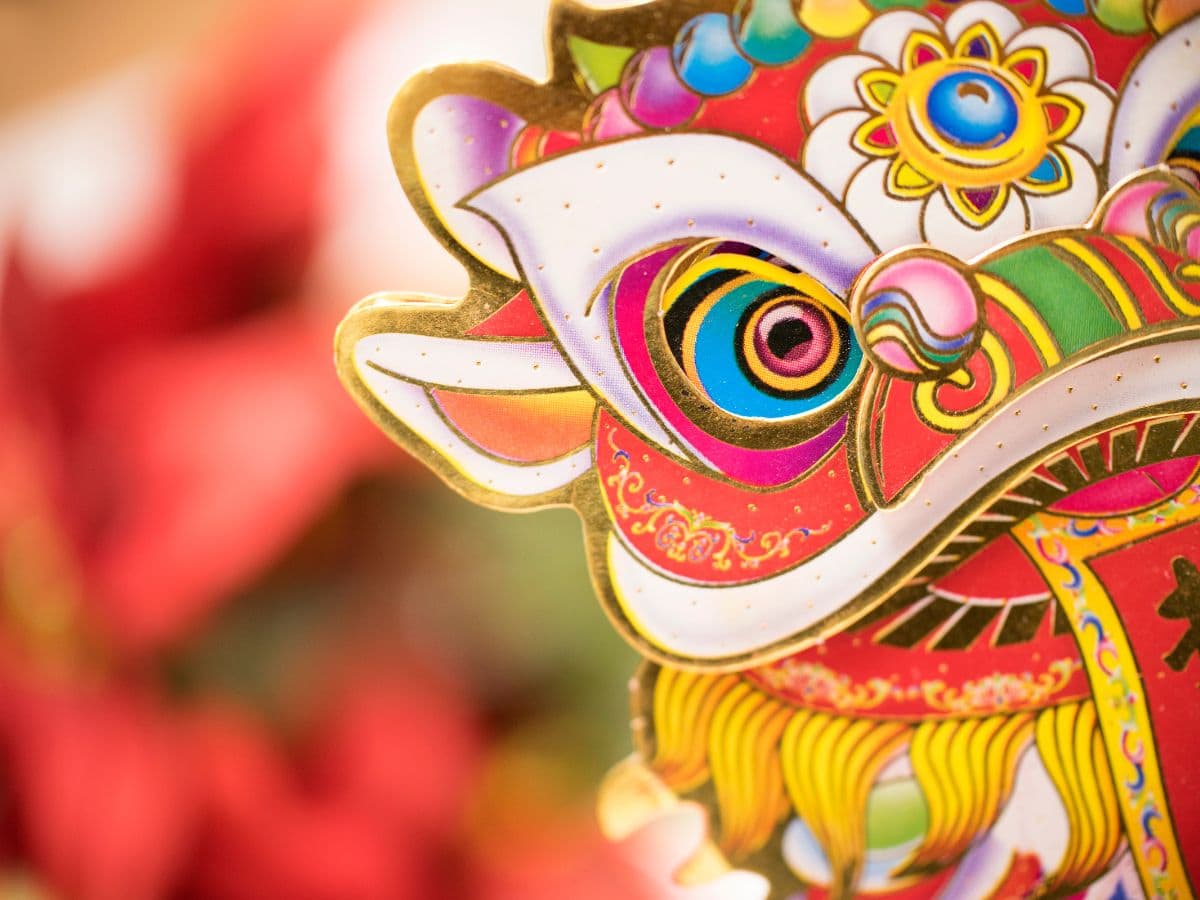
Another important feature of Chinese New Year is the lion dance. The dances showcase the rich heritage and artistry of Chinese culture, captivating audiences with their vibrant colors, rhythmic movements, and infectious energy.
The appearance and style of the lion dance can differ depending on the region in China, reflecting the diverse cultural heritage and traditions found throughout the country.
It’s important to note though, that while these regional variations exist, the basic concept of the lion dance remains the same across China. The lion is seen as a symbol of good luck, fortune, and protection, and the dance is performed to ward off evil spirits and bring blessings for the upcoming year.
GRAND FINALE
The grand finale of Chinese New Year includes dazzling displays of fireworks that light up the night sky and are believed to scare away evil spirits.
As merrymakers bid farewell to Chinese New Year, they welcome the Lantern Festival. It marks the end of the celebration with beautiful glowing lanterns, riddles, and sweet treats. We will tackle all its intricacies in a future blog post.
So, folks, I hope you enjoyed this whirlwind journey through Chinese New Year! From the monster Nian to firecrackers, lion dances, lanterns, and mouthwatering feasts, it’s a celebration that can truly ignite the senses.
If you enjoyed it and want to explore more fascinating Chinese Traditions and Celebrations, don’t forget to subscribe to my blog and YouTube Channel so you can catch our next episode.
Until then, be well, stay curious, and embrace the rich tapestry of cultures that make our world so incredible.